







|
बी एड - एम एड >> बीएड सेमेस्टर-2 अंग्रेजी शिक्षण बीएड सेमेस्टर-2 अंग्रेजी शिक्षणसरल प्रश्नोत्तर समूह
|
5 पाठक हैं |
||||||
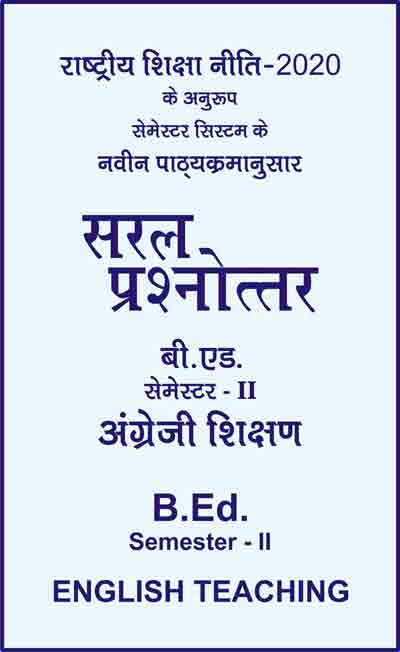

बीएड सेमेस्टर-2 अंग्रेजी शिक्षण - सरल प्रश्नोत्तर
Question- What are the various kinds of remedial teaching?
Ans.
The various kinds of remedial teaching are :
(i) Small Group Tutoring : During this, remedial student's are sent off in small groups to support the ones who are falling behind. A common teaching strategy is observed to allow higher achieving student's to work in groups alone. This gives time for the teacher to spend focussed time with a small group of students who need additional support.
(ii) One-To-One Tutoring : In this tutoring, either a trained specialist, the classroom teacher or a volunteer spend individual time with a student. It is basically resource intensive hence it is often hard to find enough time and staff to have one-to-one interventions while also supporting the rest of the class.
(iii) Private Tutoring : It is one of the most popular formats for remedial support. Parents who have the funds to send their children to after-school tutoring may use this as an option to help ensure their student's keep up with their peers.
(iv) Specialist Tutoring : Trained specialists can be employed to help student's reach benchmarks. Often, schools employ trained specialists to come into classrooms and take one-to-one or small group sessions with student's in need.
(v) Volunteer Tutoring : Schools often rely on volunteer tutors to help provide additional support to remedial student's. This may take the form of parent's helpers to help the teacher and get to know the class better. However, finding volunteers can be a problem.
(vi) Peer Tutoring : Peer tutoring involves one student helping another student on their work. This may take the form of older student's coming into the classroom to help younger student's.
(vii) Withdrawal System : It involves removing student's entirely from a mainstream classroom for a short (one lesson) or long (indefinite) time to give tailored support. However, the challenge is that it might stigmatize student's and exclude them from participation in main stream activities.
(viii) Computer Assisted Interventions : Computer Assisted Interventions (CAIs) provide remedial education via computerized lessons. Computers provide self-paced lessons for mastery of content. It also includes pause and rewind possibilities. Moreover, such kind of tutoring is accessible both to rural and remote student's. But, the cost of use of technologies and internet may act as a deterrent.
|
|||||
अन्य पुस्तकें