







|
बी एड - एम एड >> बीएड सेमेस्टर-2 अंग्रेजी शिक्षण बीएड सेमेस्टर-2 अंग्रेजी शिक्षणसरल प्रश्नोत्तर समूह
|
5 पाठक हैं |
||||||
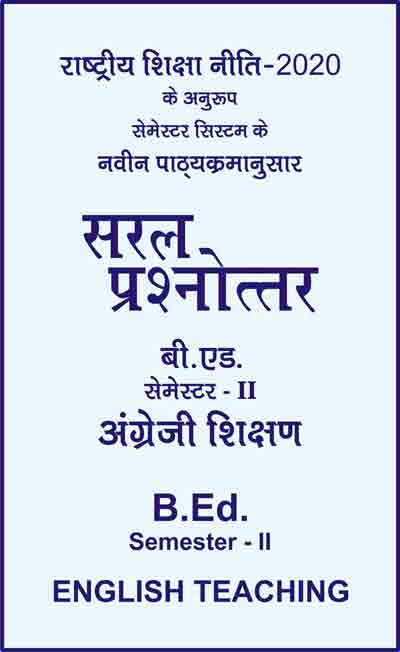

बीएड सेमेस्टर-2 अंग्रेजी शिक्षण - सरल प्रश्नोत्तर
Objective Type Questions - 1. Development of English as a Discipline
For each of the following questions, four alternatives are given for the answer. Only one of them is correct. Choose the correct alternative.
Development of English as a Discipline with
Historical Perspective, its Role and Position
in the Indian School Curriculum
-
A Language is -
(a) a broad term simply referring to human patterned verbal behaviour in general.
(b) a set of specific rules for generating speech.
(c) another word for a dialect.
(d) None of the above -
The most important factor which is responsible for differentiation between language learning and language acquisition is -
(a) Grammar of language
(b) Assessment in language
(c) Text book of language
(d) Language environment -
The process of learning language with the help of environment and with less efforts :
(a) Language Acquisition
(b) Language Device
(c) Passive Language Learning
(d) None of the above -
What was the education policy of lord Macaulay ?
(a) In 1835, Education Policy of Lord Macaulay was language of the Rulers.
(b) In 1835, Education Policy of Lord Macaulay was "Minute on Indian Education".
(c) In 1835, Education Policy of Lord Macaulay was only language of society and culture.
(d) None of these -
English is declared as an official language (Act, 1963) of Administration in form of -
(a) Language of court and states
(b) Language of Trade and Industry
(c) Language of western sciences and art
(d) Language of library
(e) All of these -
When was the Official Language Act passed in India ?
(a) Act of Parliament in 1963
(b) Act of Parliament in 1935
(c) Act of Parliament in 1930
(d) None of these -
According to Thompson and wyatt (1952) the four specific aim of teaching English are -
(a) To understand spoken English
(b) To speak English
(c) To understand written English
(d) To write English
(e) All of the above -
Which one of the following recommended the "Three Language Formula"?
(a) National Policy on Education, 1968
(b) National Policy on Education, 1986
(c) Kothari Commission, 1966
(d) Chattopadhyaya Commission, 1985 -
What is "The three-language formula" as stated in the 1968 Policy is -
(a) The first language - studied must be the mother tongue or the regional language.
(b) The second language - hindi speaking states, the second language will be english or some other modern Indian language. In non - hindi speaking states, the second language will be Hindi or English.
(c) The third language is taught at a later stage in school.
(d) All of the Above statements are true. -
Why is the three language formula being implemented not effectively all over the country ?
(a) Different states interpreted this formula in different ways.
(b) As a result its implementation has been uneven.
(c) Both (a) and (b)
(d) None of these -
According to "Allen", language definition is -
(a) Language is a means of social control .
(b) Language is as a means of Communicating thoughts.
(c) Language is a social activity rather than as a means of Individual self expression.
(d) All of the above -
Who is the founder of English Language in India ?
(a) Lord Macaulay
(b) Chaucer
(c) Shakespeare
(d) Milton -
When did English become the official language of India ?
(a) After Independence from British Rule in 1946.
(b) After Independence from British Rule in 1947.
(c) Both are true.
(d) None of these. -
The main element of curriculum development is -
(a) Teaching objectives
(b) Progress of evaluation.
(c) Both (a) and (b)
(d) None of the above. -
Important factor of curriculum is to help to achieve the :
(a) Education
(b) Objectives
(c) Values
(d) Job -
Curriculum is :
(a) Course
(b) Syllabus
(c) Co-curricular
(d) Overall activities of an institution. -
Which of the following is the nature of curriculum ?
(a) Creative
(b) Critical
(c) Conservative
(d) All of the above -
.......... approach is a classical approach to curriculum organization.
(a) Topical
(b) Concentric
(c) Spiral
(d) Logical -
.......... mentioned curriculum as a tool in the hands of the artist.
(a) Hilda Taba
(b) Cannigham
(c) Manroe
(d) Crow Crow. -
The word, 'career' means -
(a) a race course
(b) a method
(c) syallbus
(d) textbook -
Curriculum presents instructional material is stated by :
(a) Elizabeth Macis
(b) Jack Kerr
(c) W. Teller
(d) Smith -
Curriculum emphasized for primary classes is :
(a) Teacher centred curriculum
(b) Integrated curriculum
(c) Subject based curriculum
(d) None of these -
The purpose of Intergrated curriculum is :
(a) Increase in no. of books
(b) Decrease in no. of books
(c) Increase in student enrolment
(d) Decrease in dropout -
Curriculum improvement should a ............ process.
(a) last
(b) initial
(c) internal
(d) continuous -
Which approach to organise curriculum is based on the principle of social relevance of the context ?
(a) Concentric approach
(b) Spiral approach
(c) Unit approach
(d) Integrated approach -
Establishment of DIETs (District Level Educational Institute) was a result of one of the recommendations of -
(a) Education Commission - 1966
(b) University Education Commission - 1948-49
(c) Secondary Education Commission - 1952-53
(d) National Policy of Education - 1986 -
............ recommends that the institutions of national importance like UGC, NCERT, NIEPA, AICTE, etc. will be strengthened to national system of education.
(a) Kothari Commission (1964-66)
(b) National Policy of Education (1986)
(c) National Curriculum Framework
(d) National System of Education -
Improvements of 'girls' access to technical, vocational and professional education was recommended by -
(a) National Commission on Techers (1999)
(b) National Knowledge Commission (2007)
(c) National Policy of Education (1992)
(d) Kothari Education Commission (1964-66) -
One of the objectives of education is to conserve scientific and democratic attitude, is given in the ........ report .
(a) Kothari Education Commission (1964-66) report
(b) National Policy of Education (1986, 1992)
(c) National Curriculum Framework for Teacher Education (2009)
(d) Yaspal Committee Report (2009) -
As per the National Education Policy 2020, the school education curriculum is devided into the following pedagogical stages :
(a) Foundational stage
(b) Elementary stage
(c) Preparatory stage
(d) Secondary stage
(e) Middle stage
(a, b, c, d and e)
(b) a, c, d and e
(c) a, c, e and d
(d) b, d, a and e -
Who established the Secondary Education Commission in India ?
(a) The Government of India, under the chairman of Dr. Lakshmanswamy Mudaliar.
(b) The Government of India, under the chairman ship of Dr. Radha Krishnan.
(c) Indian Education Commission, under the chairman of Daulat Singh Kothari.
(d) None of the above -
Secondary Education Commission was also known as ............ .
(a) Kothari Commission
(b) Mudaliar Commission
(c) New Education Policy
(d) National Policy on Education -
Kothari Commission, was an adnoc commission was popularly known as-
(a) Secondary Education Commission
(b) Mudaliar Commission
(c) National Education Commission
(d) None of the above -
Kothari commission strongly recommended for ..........
(a) Primary Education
(b) Distance Education
(c) Secondary Education
(d) All of the above -
When was the University Education Commission established in India ?
(a) In 1948, under the chairman of Dr. Radha Krishnan.
(b) In 1949, under the chairman of Dr. Radha Krishnan.
(c) In 1952, Secondary Education Commission.
(d) None of these. -
Which government educational body will prepare national curriculum framework for school education (NCFSE) based on the principles of National Education Policy 2020 ?
(a) IITS
(b) SCERT
(c) MHRD
(d) NCERT -
National Education Policy 2020 is headed by ?
(a) Dr. S. Kothari
(b) R. G. Sinha
(c) Dr. K. Kasturrirangan
(d) All of these -
FIRST Education Policy is passed by Indian Parliament in which year ?
(a) 1965
(b) 1978
(c) 1968
(d) None of these -
As per Noam Chomsky's theory, the role of Language Acquisition Device (LAD) helps children to -
(a) Learn Second Language
(b) Communicate activity in second language
(c) Generate grammer school
(d) Imitate the language spoken by adults. -
Which of the following statements is correct ?
(a) First language is a hurdle in learning english.
(b) As a teacher you would like to give a list of english words on the very first day.
(c) It is difficult to teach english as they use their first language in every aspect.
(d) Children come to school with a treasure of experience and their mother tongue acts like a resource in learning english. -
How many phonemes (sounds) are there in the english language ?
(a) 24
(b) 21
(c) 44
(d) 40 -
English language has ........ consonant sounds.
(a) 21
(b) 22
(c) 24
(d) 23 -
What are the three basis of english language ?
(a) (i) syntax (ii) morphology (iii) phonology
(b) (i) morphology (ii) phonology (iii) syntax
(c) (i) Phonology (ii) morphology (iii) syntax
(d) None of the above -
According to National Curriculum Framework, 2005, English in India is .......... in a multilingual country ?
(a) Foreign language
(b) First language
(c) Global language
(d) Associate language -
The study of how words combine to form phrases, phrases combine to form clauses and clauses join to make sentences is known as -
(a) Collocation
(b) Syntax
(c) Semantics
(d) Colloquial -
A child got admission to new school. The teacher was surprised to see that she would speak four languages fluently but could not speak in english. She is ..........
(a) monolingual
(b) bilingual
(c) multilingual
(d) Liguist -
What is the proper order of english language learning ?
(a) Listening, speaking, reading, writing
(b) Reading, writing, speaking, listening
(c) Listening, reading, speaking, writing
(d) Reading, listening, speaking, writing -
Language learning is related to -
(a) Knowledge
(b) skills
(c) Power
(d) Copying
|
|||||
अन्य पुस्तकें