







|
बी एड - एम एड >> बीएड सेमेस्टर-2 अंग्रेजी शिक्षण बीएड सेमेस्टर-2 अंग्रेजी शिक्षणसरल प्रश्नोत्तर समूह
|
5 पाठक हैं |
||||||
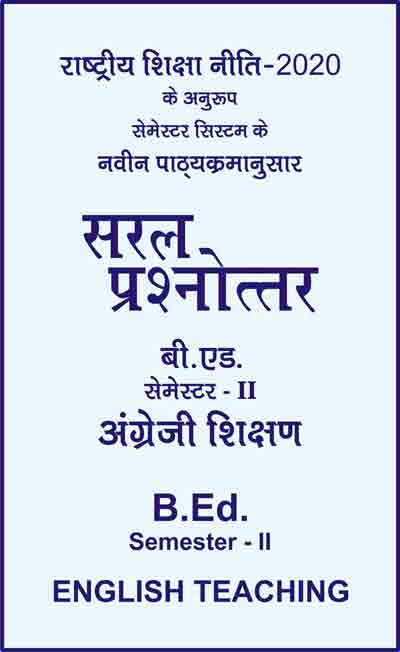

बीएड सेमेस्टर-2 अंग्रेजी शिक्षण - सरल प्रश्नोत्तर
Question- How are the results of the students rewarded in CCE ?
Ans.
Recording the results of the students has to be done keeping in mind the scholastic and co-scholastic activities. First and foremost, the general information i.e., student's name, class, section, roll number, father's and mother's name, residential address, date of birth etc. is to be provided.
Attendance is to be provided term-wise in percentage as well as working days.
Part 1 - Consists of the academic performance of the student in scholastic areas :
Part 1 : Scholastic Areas :
There are two terms. The first term is from April-September and the second term from October-March.
Each term has two formative and one summative assessment.
Assessment is indicated in Grades.
The grading scale for the scholastic areas is a nine point grading scale.
Overall grade of formative assessments over the two terms (FA1 + FA2 + FA3 + FA4) and the overall grade of summative assessments (SA1 + SA2) is given. The total of the two grades which comprises formative and summative, needs to be given in the relevant column.
Part 2 - Co-scholastic Areas :
Assessment of co-scholastic areas is being done in four parts on a five point grading scale one in a session.
Part 2(A) : It includes 10 life skills consisting of self awareness, problem-solving, decision-making, critical thinking, creative thinking, interpersonal relationships, effective communication, empathy, managing emotions and dealing with stress.
Part 2(B) : It includes work education whose assessment is being done based on descriptive indicators.
Part 2(C) : It includes Visual and Performing Acts - Here, again assessment is done based on some descriptive indicators.
Part 2(D) : It reports the grading of students on attitudes towards teachers, Schoolmates, School programmes and environment. These are filled through observation over the years by the class teacher in consultation with the subject teachers.
Part 3 - Co-curricular Activities : Assessment of co-curricular activities has two sub-parts and is done on a five-point grading scale.
Part 3(A) : This part has four sets of skills. A student is expected to choose two activities from these four sets and will be assessed on his/her level of participation and achievement.
(i) Literary and creative skills.
(ii) Scientific skills.
(iii) Information and Communication Technology (ICT).
(iv) Organisational and Leadership Skills (Clubs).
Part 3(B) : Health and Physical Activities : There is a provision of eight different kinds of health and physical activities. One student is assessed based on any two of the given eight activities. The suggested activities are sports indigenous sports (Kho-Kho etc.), NCC/NSS, Scouting and Guiding, Swimming, Gymnastics, Yoga, First Aid and Gardening/Shramdan.
Assessment of scholastic attainments will be done twice in a year. Minimum qualifying grade is D.
Co-scholastic attainments 2 (A, B, C and D) and 3 (A, B) is done on a 5 point grading scale once in a session.
Minimum qualifying grade is D.
Q.2. What is the duration of the course?
Ans. The entire duration is 3 years with 6 semesters of six months each.
Each semester has minimum 90 working days of 18 weeks and 5 days and 5 hours.
Q.3. What are the odd semesters?
Ans. The odd semesters are from June to October.
Q.4. What are the even semesters?
Ans. The even semesters are from November to March.
Q.5. What is the total number of courses?
Ans. There are in all 31 courses which include
• 10 common courses (Code A)
• 16 Core Courses (Code B)
• 04 Complimentary Courses (Code C)
• 1 open course (Code D)
Q.6. What is the criterion of passing under CBCS?
Ans. In order to pass, one has to achieve a minimum of 120 credits which includes :
• Common 38 Credits.
• Core and complimentary 78 credits.
• Open 4 credits.
Q.7. What is the criterion kept for the attendance of the students?
Ans. The criterion kept for the attendance of the students is minimum 75% during a semester for each course with a condonation of maximum 10 days in a semester and maximum 2 times during the programme.
Q.8. How is evaluation and grading is done under CBCS.
Ans. Evaluation and grading is done in two parts :
(i) Internal Evaluation (25% weightage)
(ii) External Evaluation (75% weightage)
Q.9. What are the components of Internal Evaluation?
Ans. There are five components for Internal Evaluation :
(i) Assignment - 1 weightage
(ii) Seminar - 1 weightage
(iii) Test paper (2 test papers) - 2 weightage
(iv) Attendance - 1 weightage
Total comes to 5 weightage.
However, there shall not be any chance for improvement for internal grade.
Q.10. Enlist the main points of External Evaluation.
Ans. The main points are :
(i) It is carried out immediately after each semester.
(ii) It is based on direct grading system.
(iii) It has four types of questions:
• Multiple Choice/Objective Type Questions
• Short Answer Type Questions
• Short Essays/Problems
• Long Essays
(iv) Weightage of these 4 types of questions is ¼, 1, 2 and 4 respectively.
Q.11. What is the grade (minimum) required to pass a course and receive the degree?
Ans. A candidate should get an aggregate C grade in each course for a pass and also for awarding a degree.
Q.12. What are the internal grades for attendance?
Ans. The internal grades for attendance are :
• Above 90 – A
• 85 – 89.9 – B
• 80 – 84.9 – C
• 75 – 79.9 – D
• Less than 75 – E
|
|||||
अन्य पुस्तकें