







|
बी एड - एम एड >> बीएड सेमेस्टर-2 अंग्रेजी शिक्षण बीएड सेमेस्टर-2 अंग्रेजी शिक्षणसरल प्रश्नोत्तर समूह
|
5 पाठक हैं |
||||||
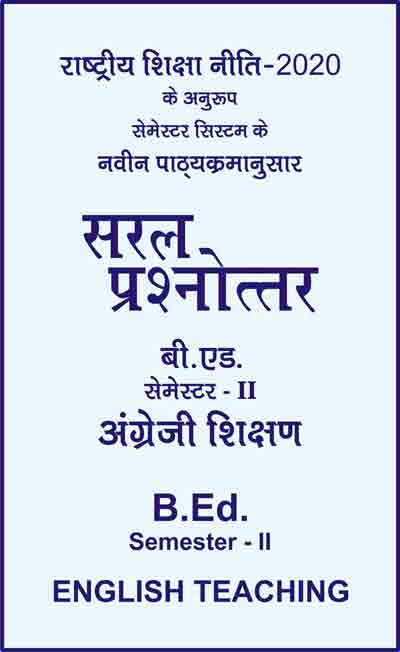

बीएड सेमेस्टर-2 अंग्रेजी शिक्षण - सरल प्रश्नोत्तर
Objective Type Questions - 6. Micro Teaching and Lesson Planning
-
Micro – teaching is -
(a) Scaled down teaching
(b) Effective teaching
(c) Evaluation teaching
(d) Real teaching -
A plan prepared by a teacher to teach a lesson is called -
(a) Unit plan
(b) Lesson plan
(c) Course plan
(d) Master plan -
The first and foremost requisite for effective lesson planning is -
(a) Sincerity and dedication
(b) Knowledge of different approaches and methods of teaching
(c) Thorough knowledge of the subject matter
(d) availability of teaching resources -
Who invented the idea of lesson plan ?
(a) John Herbart
(b) John Dewey
(c) Vygotsky
(d) Newton -
Who defined lesson plan as a “plan of action” ?
(a) John Dewey
(b) Laster B. Stands
(c) B.F. Skinner
(d) Smith Stands -
Lesson planning is important because it helps teachers ensure about the ........ activities that go on in their classrooms.
(a) Annual Activities
(b) Day – to – night Activities
(c) Day – to – Day Activities
(d) None of these -
While preparing a lesson plan, a teacher must keep in mind -
(a) Whom am I teaching ?
(b) What am I teaching; Do my learners understand ?
(c) How should I teach ?
(d) All of the above -
Lesson planning is essential for a teacher because -
(a) Through planning the subject gets lengthy.
(b) It keeps the students free from meaningful teaching.
(c) It makes the improper atmosphere for learning process.
(d) It avoids confusion in teaching process and save time. -
Which of the following statement is not true about lesson plan ?
(a) Assist the students in achieving the learning objectives, on the short term and long term as well.
(b) Is a teacher’s daily guide for what students need to learn, how it will be taught, and how learning will be measured.
(c) It developed by students.
(d) None of the above. -
Which of the following is not a step of Lesson planning ?
(a) Presentation of the content
(b) Recapitulation of content
(c) Evaluation of content
(d) Population of content -
“Mind of the child is like a blank clean slate, if the new knowledge related to previous knowledge given, it will be more easy and retainable for a longer time, this is gist of” . said by -
(a) Dowey Theory
(b) Rosseaw Thinking
(c) Socrates method
(d) Herbert Approach -
What are the five steps of Herbartain approach in lesson planning ?
(a) Preparation
(b) Presentation
(c) Comparison
(d) Generalisation
(e) Application and Recapitulation
(f) All of the above -
What are salient features of lesson plan for teaching English ?
(a) Clearly objective
(b) Knowledge of the subject
(c) Knowledge of the principles and strategies of teaching
(d) All of the above -
What are the need and importance of Lesson Planning in English ?
(a) By Lesson plan knowledge is given systematically.
(b) Lesson plan helps to make the lesson interesting and effective.
(c) Helps to maintain discipline and to control the students behaviour during teaching .
(d) All of the above -
What are lesson plans for grammar ?
(a) Lesson plans for specific grammar related topics verb, adverb, noun and pronoun
(b) Parts of speech lesson plans with related exercises
(c) Syntax in writing, practice of composition exercises
(d) All of the above -
What are the general objectives of lesson planning in English prose ?
(a) To read aloud prose lessons with correct pronunciation stress, intonation and pause
(b) To enable the students to comprehend the thought and idea contained in the passage
(c) To enable the students to express the ideas contained in the passage orally with vocabulary and to write correctly
(d) All of the above -
To know value / worth / significance of information / material is called -
(a) Knowledge
(b) Comprehension
(c) Evaluation
(d) Synthesis -
What are the general objectives of lesson plan for an essay ?
(a) To develop the ability and skill among students to write correct English.
(b) To help or assist the student in developing writing skill of English or linguistic skills.
(c) To develop students way of expression, imagination, feelings and interest in English Language.
(d) All of the above -
Micro Teaching was invented by -
(a) D.D. Tiwari
(b) Dwight Allen
(c) Kurt Lewin
(d) Kilpatrick -
Condition necessary for micro-teaching is -
(a) Observation and feedback
(b) Controlled environment
(c) Repeated manifestation of only one skill
(d) All of the above -
Micro-teaching is :
(a) Teaching micro-concepts of the subject
(b) Teaching at micro level
(c) Providing detailed explanation of concepts and principles
(d) Practicing different teaching skills -
What are the important steps of the cycle of micro teaching in English ?
(a) First, plan, second-Teach
(b) Third – Feedback, fourth-Re-plan
(c) Fifth, Re-teach, sixth – Re-feedback
(d) All of the above -
Herbartian approach is based on -
(a) Appreceptive mass theory of Learning
(b) Cognitive approach of learning
(c) Affective approach of learning
(d) None of the above -
Herbartian Approach contributed to the field of -
(a) educational method of conception
(b) educational psychology
(c) educational motivation
(d) All of the above -
What are three steps of lesson planning as per RCEM approach ?
(a) Input
(b) Process
(c) Output
(d) All of these -
How does an introductory statement help a student learn a new concept ?
(a) It helps the student learn how to begin an answer on that topic.
(b) It helps the student to become attentive in the class and to have an idea about what is going to be taught.
(c) It is not helpful at all and every teacher should avoid it.
(d) None of the above. -
What are teaching objectives in lesson plan by using the NCERT approach ?
(a) Knowledge and Comprehension
(b) Expression Application and Skills
(c) Interest and Attitude
(d) All of the above -
Arrange the following steps in lesson plan in the suitable order -
(a) Review and Drill
(b) Organisation of learning
(c) Presentation
(d) Summarisation
(e) Evaluation
Choose the correct option given below –
(a) b, a, d, c, e
(b) a, b, c, d, e
(c) c, d, b, a, e
(d) c, d, a, d, e -
The Inclusion of blackboard work in the lesson plan is to -
(a) Highlight the important points on the blackboard during teaching
(b) Keep the blackboard neat
(c) Write blackboard work before the beginning of the class
(d) None of the above -
Lesson plan is to developed, keeping in view one of the following -
(a) Teaching competency
(b) Availability of text book
(c) Availability of Teaching Aids
(d) Objectives -
Writing a lesson plain on any topic should focus on -
(a) Cognitive domain
(b) Affective domain
(c) Psychomotor domain
(d) All of the above -
Teaching without a proper planning will lead to -
(a) Realization of objectives
(b) Better learning on the part of the student
(c) Optimum satisfaction of the teacher
(d) Chaos in the class -
Lesson plan helps the teacher like a -
(a) Guide
(b) A rule
(c) A Framework
(d) A reference -
Planning for teaching a part or concept of a lesson is -
(a) Lesson plan
(b) Period plan
(c) Annual plan
(d) Unit plan -
What are the advantages of Herbartian Lesson plan ?
(a) Organised Teaching
(b) Recapitulation is done
(c) Use of inductive and deductive method
(d) Correlation is possible
(e) All of the above -
What are the limitations of Herbartion plan ?
(a) Mechanical method of Teaching
(b) No place for individual difference
(c) Useful in knowledge to lesson only
(d) All of the above -
Which is not the characteristic of a good lesson plan in Herbartian approach ?
(a) The lesson plan is divided into units.
(b) There is no scope for self-evaluation.
(c) Use of illustration is possible.
(d) Homework can be suitably assigned. -
Which is not correct characteristics of the RCEM system ?
(a) Writing or converting objectives into behavioural terms.
(b) This system has been developed according to Indian conditions.
(c) All the educational objectives cannot be written in behavioural terms.
(d) None of the above. -
___ test measure the extent of students learning in a given content area.
(a) Achievement Tests
(b) Aptitude Tests
(c) Diagnostic Tests
(d) Readiness Tests -
In 2001, the Revised version of Bloom’s Taxonomy was provided by -
(a) Lorin Anderson
(b) David Krawthwohl
(c) Benjamin Bloom
(d) Lorin Anderson and David Krawthwohl -
In which level, a student can be able to formulate, build, invent, create, compose, generate, derive, modify and develop ?
(a) Evaluating
(b) Creating
(c) Remembering
(d) Analyzing -
By the end of this lesson, the student will be able to calculate the kinetic energy of a projective. This example is an learning objective of -
(a) Applying
(b) Understanding
(c) Synthesis
(d) Knowledge -
In which order the levels of the Taxonomy are followed ?
(a) Lower – Higher
(b) Higher – Lower
(c) Lower – Medium
(d) Higher – Medium -
In which level, students will be able to describe Newton’s three laws of motion to in her / his own words ?
(a) Remembering
(b) Understanding
(c) Creating
(d) Analyzing -
According to the objectives of Taxonomy, before you can understand a
concept, you must ........ it.
(a) Analyze
(b) Synthesize
(c) Create
(d) Remember -
The committee who developed the taxonomy, identified how many
domains of educational activies?
(a) One
(b) Two
(c) Three
(d) Four -
The Highest level of learning in cognitive domain is -
(a) Knowledge
(b) Synthesis
(c) Evaluation
(d) Analysis -
Examining and breaking down information / material into parts is
known as -
(a) Knowledge
(b) Comprehension
(c) Application
(d) Analysis
|
|||||
अन्य पुस्तकें