







|
बी एड - एम एड >> बीएड सेमेस्टर-2 अंग्रेजी शिक्षण बीएड सेमेस्टर-2 अंग्रेजी शिक्षणसरल प्रश्नोत्तर समूह
|
5 पाठक हैं |
||||||
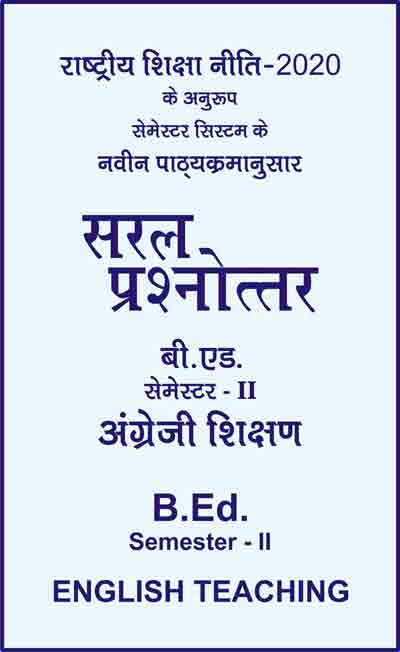

बीएड सेमेस्टर-2 अंग्रेजी शिक्षण - सरल प्रश्नोत्तर
Objective Type Questions - 5. Various Approaches of Teaching English
-
What are the various methods of teaching in English ?
(a) Translation cum grammar method
(b) Bilingual method
(c) Direct or natural method
(d) Audio-lingual method or the structural approach
(e) Language laboratory method
(f) Situational approach and Herbartian method
(g) All of the above -
What are the features of structural approach in teaching English language ?
(a) Word order
(b) The patterns of form
(c) both (a) and (b)
(d) None of the above -
Situational Language Teaching is also known as –
(a) The oral approach
(b) Direct method
(c) Holistic approach
(d) None of the above -
Which is not the criteria for the selection of structures ?
(a) Usefulness
(b) Productivity
(c) Simplicity and Teachability
(d) Familiarity Trap -
The structural approach emphasizes that –
(a) Only vocabulary items be sequenced
(b) Only the phonemic items be sequenced
(c) Only the difficult items be sequenced
(d) The essential structures and vocabulary be selected for teaching practices -
Which of the following cannot be an advantage of structural method ?
(a) Carefully selected and graded language material
(b) Suitable for higher classes
(c) Language is taught in a meaningful situation
(d) Stress on habit formation -
The situational approach to language teaching, tries to teach English in the same manner as the child learn –
(a) Second Language
(b) First language
(c) Foreign Language
(d) National Language -
In the situation approach a teacher tries to –
(a) Follow a syllabus with the list of situations.
(b) Adjust teaching to the situation in the classroom.
(c) Create a life like situation in the classroom for teaching a language item.
(d) Show how the situation in the classroom is different from real life situations. -
Communicative language teaching is concerned with –
(a) Teaching of vocabulary and grammar rules of spelling and language
(b) Teaching language to learners for written-test
(c) Interpreting grammar rules to suit the audience
(d) Enhancing receptive and productive skills such as speaking, listening reading and writing. -
The structural approach advocates –
(a) Using mother tongue
(b) Resorting to fluency
(c) Selection and gradation of material
(d) Assessing learner’s performance -
B.F. Skinner claimed that language is learnt through –
(a) repetition and approximation
(b) immersion and employment
(c) reinforcement and engagement
(d) drill and practice -
Structural Approach gives more importance to –
(a) Speech and reading
(b) reading only
(c) Speech only
(d) reading and writing -
Structural approach requires certain definite steps, out of these steps first step is –
(a) Oral drill
(b) Vocabulary expansion
(c) Presentation
(d) Exercise -
Communicative Language Teaching replaced basically –
(a) Naturally Language Processing
(b) Structural Teaching
(c) Situational Language Teaching
(d) Motivational Teaching -
Communicative approach is based upon the –
(a) Needs analysis
(b) Communicative curricular and syllabus
(c) Functional utility of language
(d) Used of language accurately and appropriately
(e) All of the above -
Communicative language teaching stresses the interdependence of –
(a) Language and Psychology
(b) Language and behaviour
(c) Language and communication
(d) Language and Conversation -
The most important element in communication language teaching is –
(a) The structure of language
(b) The reading skill
(c) Memorization of grammar
(d) Meaning -
Communicative competence has –
(a) Strategic competence
(b) Discourse competence
(c) Grammatical competence
(d) Sociolinguistic competence
(e) All of these -
The main aim of communicative language teaching is to –
(a) Provide communicative competence to learners.
(b) Focus on the structure of the target language.
(c) Emphasize the use of English as library language.
(d) Encourage learners to speak like native speakers of English. -
Which of the following techniques is not followed in the communicative language teaching ?
(a) Pattern practice
(b) Language games
(c) Opinion Sharing
(d) Unscrambling of Scrambled sentences -
______ of language and meaning important in communication language Teaching.
(a) Form
(b) Structure
(c) Contextualization
(d) All of the above -
What is the role of the student in communicative language Teaching ?
(a) Silent observer
(b) Speaker and negotiator
(c) There is no role of student
(d) None of the above -
What are the benefits of holistic approach to language learning ?
(a) Helps students develop internal values and morals.
(b) Builds confidence and encourages a sense of identity.
(c) Eliminates the problem of unrealistic expectations.
(d) Develops social and practical life skills.
(e) All of the above. -
What is the ultimate goal of the holistic approach ?
(a) establish healthy social relationship
(b) develop a student’s physical, emotional and spiritual traits
(c) good way of teaching – learning for prepares learners in a highly effective way
(d) All of the above -
What are the effective ideas in holistic approach to language learning ?
(a) Information visualization
(b) Use of Technology
(c) Individuals projects and Group activities
(d) All of the above -
Which of the following cannot be essential features of holistic language learning ?
(a) Outdoor classes
(b) Learning through games
(c) Oral – drill
(d) Student – Led classroom -
What is holistic approach to learning ?
(a) An approach that seeks to fully activate all aspects of learner’s personality
(b) For more effective and comprehensive learning
(c) Both (a) and (b)
(d) None of the above -
What are the five aspects of holistic development ?
(a) Physical and intellectual development
(b) Social and emotional development
(c) Spiritual development
(d) All of the above
|
|||||
अन्य पुस्तकें