







|
बी एड - एम एड >> बीएड सेमेस्टर-2 अंग्रेजी शिक्षण बीएड सेमेस्टर-2 अंग्रेजी शिक्षणसरल प्रश्नोत्तर समूह
|
5 पाठक हैं |
||||||
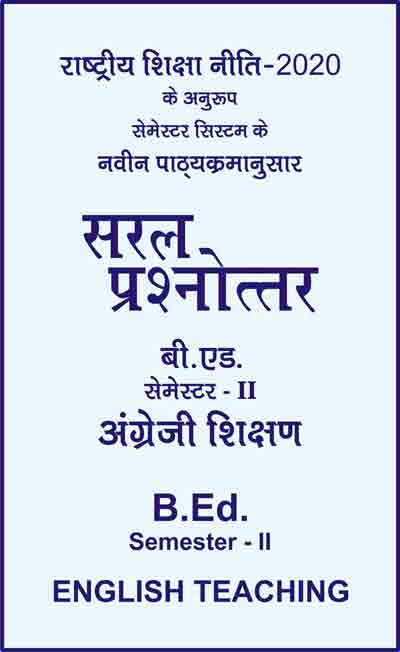

बीएड सेमेस्टर-2 अंग्रेजी शिक्षण - सरल प्रश्नोत्तर
Objective Type Questions - 2. Aims and Objectives of Teaching English
-
The Education Commission pleaded by stressed the need for studying English as a compulsory subject to acquire at least a "working knowledge" of English.
(a) D. G. Kothari
(b) N. K. Singh
(c) S. R. Bomani
(d) V. R. Gonak -
In the system of language teaching and learning, the system of constructing words is called -
(a) Syntax
(b) Morphology
(c) Semantics
(d) Phoentics -
Which domain or aspect of student's behaviour is related to his interests and attitudes ?
(a) Intelligence domain
(b) Affective (Emotional) domain
(c) Psychomotor domain
(d) Cognitive domain -
Write the correct answer from the options given below, from lower to higher, for indicating learning outcomes related to affective domain ?
(A) Receiving (B) Valuing (C) Responding (D) organization (E) Characterization
Choose right answer in order
(a) A, B, C, D and E
(b) A, C, B, D and E
(c) C, D, E, A and B
(d) B, C, A, D and E -
Which of the following is considered as the objective of application ?
(a) Read effectively
(b) Use Vocabulary
(c) Put central words in your own words
(d) Define Statement -
Which of the following learning strategies are not developed by B.S. Bloom ?
(a) Administering Unit Test
(b) Diagnose the learning difficulties
(c) Attain mastery level by teachers
(d) Division the learning difficulties -
The 'doing' aspect of behavior falls in the -
(a) Cognittive domain of learning
(b) Cognitive domain of learning
(c) Affective domain of learning
(d) Psychological domain of learning -
A student is aggressive in his behaviour towords his peer group and does not conform to the norms of the school, this student needs help in -
(a) Cognitive domain
(b) Psychomotor domain
(c) Affective domain
(d) Higher order thinking skills -
Which of the following learning outcome based behaviours belong to the category of being high in terms of taxonomic categories in cognitive domain ?
(a) Analysis
(b) Application
(c) Comprehension
(d) Creation
(e) Critical thinking
(f) Knowledge
Select the right answer from the following options :
(a) a, c and e
(b) a, d and e
(c) b, d and f
(d) c, d and e -
In which of the following set is the highest level category of taxonomies in cognitive, affective and psycho-motor domains ?
(a) Sythesis, Valuing, Articulation
(b) Analysis, Receiveng, Manipulation
(c) Application, Organization, Precision
(d) Evaluation, characterization, Naturalization -
Which of the most effective solution here the most qualified candidate, articulate and justify the new budget ?
(a) Application
(b) Evaluation
(c) Creation
(d) Analysis -
Which of the following educational objective is not included in creativity category according to RCEM method ?
(a) Evaluate
(b) Synthesize
(c) Analyze
(d) Verify -
R.C.E.M. approach of lesson planning cognitive objectives into -
(a) 17 Categories
(b) 16 Categories
(c) 13 Categories
(d) 8 Categories -
R.C.E.M. Approach's basic elements based on ..........
(a) Psychomotor objectives
(b) Bloom's Taxonomy
(c) Affective and Cognitive objectives
(d) None of the above -
R.C.E.M. Approach's equally applicable for ................
(a) Cognitive, affective and psychomotor domain
(b) Verify, Evaluation, creativity domain
(c) Knowledge, comprehension, application domain
(d) None of the above -
R.C.E.M. Approach is effectively applicable and recommended for writing objectives in -
(a) Mental process or abilities
(b) Behavioural terms
(c) both (a) and (b)
(d) None of the above -
Which of following sentences is right as demerits of R.C.E.M. approoach -
(a) This approach suggested only 17 mental abilities process but Gieford suggested 120 mental abilities.
(b) It is difficult to differentiate among cognitive, affective and psychomotor objectives.
(c) Sometimes, it is difficult to select appropriate mental process for a specific content element.
(d) All of the above -
Behavioural objectives relate ............
(a) Teaching to the learning
(b) Learning experiences and change of behaviour
(c) Both (a) and (b)
(d) None of the above -
Four advantages of writing objectives in behavioural terms -
(a) helps is determining and delimiting the teaching objectives.
(b) helps is intergration of teaching learning process.
(c) helps is selection of appropriate teaching strategies and tatcis.
(d) helps in making teaching object-centred.
(e) All of the above. -
This ability to use learnt material in a new situation by the child making use of his previous knowledge to solve the problem, is called -
(a) Analysis
(b) Application
(c) Synthesis
(d) Knowledge -
Which of the following is right example of higher-order of cognitive learning outcome ?
(a) Learning of facts and their sequences
(b) Learning roles and action sequences
(c) Learning of conceptions and abstractions
(d) Learning of awarness and valuing -
The question (example) "How could you prove (say) that the earth is round or not round"? is based on the .......... objective of learning .
(a) Comprehension
(b) Evaluation
(c) Application
(d) Synthesis -
Tick the correct answer of cognitive behaviours in the taxonomy of educational objectives -
(a) Knowledge
(b) Application
(c) Understanding
(d) Analysis
(e) Synthesis
Choose the right answer in order form -
(a) a, b, c, d, e
(b) d, e, a and c
(c) a, c, b and e
(d) d, e, a, c and b -
According to Bloom's taxonomy which option is wrong for the preparation of objective based question ?
(a) Analysis
(b) Evaluation
(c) Self actualization
(d) Application -
This domain deals with the emotion, attitudes and interests of the students -
(a) Affective
(b) cognitive
(c) Psychomotor
(d) Developmental -
The lowest level of cognitive achievement is -
(a) Knowledge
(b) Application
(c) Understanding
(d) Analysis -
Which one of the following is the aim of value education ?
(a) To inculcate social values
(b) To inculcate moral values
(c) To inculcate political values
(d) To inculcate economic values -
Which one is the highest level of (heigranchy) cognitive ability ?
(a) Analyzing
(b) Knowing
(c) Evaluating
(d) Understanding -
The main objective of teaching is -
(a) scoring high marks in the exam.
(b) complete the syllabus thoroughly.
(c) creating lifelong learners.
(d) helping to get suitable placement. -
Which of the following is a domain of learning ?
(a) Experimental
(b) Affective
(c) spiritual
(d) Professional -
Which of the following cognitive verbs are used to analysize information given ?
(a) Differentiate
(b) Classify
(c) Describe
(d) Identify -
The classification of cognitive domain was presented by -
(a) Benjamin S. Bloom
(b) Skinner
(c) Krathwohl
(d) Simpson -
The intellectual skills and attitude are respectively reflected by -
(a) Cognitive and affective domains
(b) Affective and cognitive domains
(c) Affective and psychomotor domains
(d) Cognitive and psychomotor domains -
Which domains is concerned with physical and motor skills ?
(a) Cognitive domains
(b) Affective domains
(c) Psychomotor domains
(d) None of the above -
Which of the following can be citied as an example of cognitive domain ?
(a) Describe a specific topic
(b) Develop a photographic film
(c) Type an asay
(d) None of the above -
First the students will make a prediction of what will happen in the story. Then the students must make a list of the main events in the story. Lastly, will write a review of the story. What skills are being used?
(a) application, synthesis and evaluation
(b) comprehension, knowledge and anayalysis.
(c) Comprehension, knowledge and synthesis
(d) All of the above -
Example of Psychomotor domain is that student -
(a) Demonstrates awarness to environmental pollution.
(b) Performs an experiment
(c) Can computer results of two experiments.
(d) Can narrate a story -
Example of cognitive domain is -
(a) Describe a topic
(b) Develop an x-ray film
(c) Type a letter
(d) Take responsibility for tools -
Taxonomy of educational objectives was presented in -
(a) 1946 |
(b) 1956
(c) 1966
(d) 1976 -
As classified by Bloom, which one of the following is not a subdomain of cognitive domain ?
(a) Application
(b) Analysis
(c) Synthesis
(d) Responding
|
|||||
अन्य पुस्तकें